Storm paperweight
Station ElevenThe Storm paperweight is a lump of glass with a storm cloud trapped inside, treasured by Kirsten Raymonde from the night Arthur Leander dies onstage. It has no practical use and adds weight to the few possessions she carries, yet she keeps it for its beauty. The novel also returns to a clouded-glass paperweight given by Clark Thompson to Miranda Carroll, making the object a recurring point of contact between private attachment and the material traces that survive the collapse.
Form and First Appearance
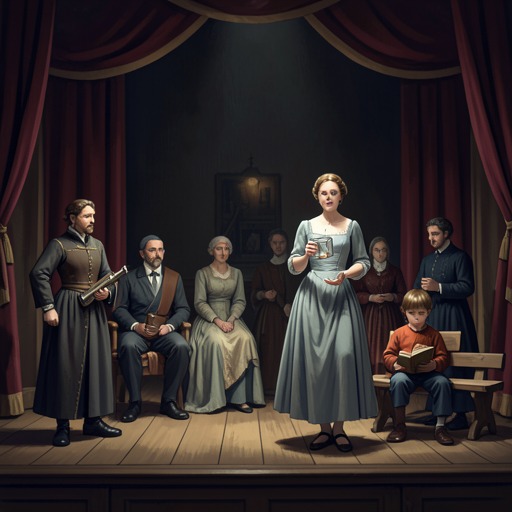
In the children’s dressing room at the Elgin Theatre, Tanya places the paperweight in Kirsten’s hands. Kirsten is a few days shy of her eighth birthday, tearful and breathless; Tanya says she will keep trying to reach Kirsten’s parents and asks her to look at the pretty thing. The object briefly gives the distressed child something to attend to. Its storm cloud is fixed inside the glass: weather made still, held in a form she can examine while the adults around her face an uncertain night.
The gift arrives amid the aftermath of Arthur’s death. In the lobby, people at the bar toast him, watch snow falling beyond the glass doors, and then separate into the storm. The bartender who joins the toast survives longer than the others gathered there, but dies three weeks later on the road out of the city. Against this movement from theater to storm-darkened streets, the paperweight remains a small, graspable thing given to a child. The scene does not make it a practical safeguard; its immediate importance is the beauty and attention it offers Kirsten while Tanya tries to comfort her.
Kirsten’s Keepsake
Years later, Kirsten carries the paperweight in a child-size red canvas backpack bearing a cracked, faded Spider-Man image. The bag holds only a few chosen supplies: two glass bottles that once contained Lipton Iced Tea, a sweater, a face covering for dusty houses, wire for picking locks, a ziplock bag of clippings and Dr. Eleven comics, and the paperweight. Kirsten has kept the load light, but makes room for this object despite its uselessness. It is a dead weight by practical standards, and a beauty by hers.
When she takes it out, she holds it briefly in her palm before turning to the clippings. She remembers that a woman gave it to her just before the collapse, but cannot remember the woman’s name. The earlier theater scene identifies Tanya as the giver, while Kirsten’s later recollection shows how even a treasured object can outlast the circumstances and personal details attached to it. Her memory preserves the gift’s beauty more securely than its provenance.
The paperweight’s place among Kirsten’s possessions is distinct from the things that help her travel or survive. The wire can open locks; the bottles carry water; the sweater and face covering answer bodily needs. The paperweight does none of these things. Kirsten keeps it because usefulness is not the only measure by which she chooses what belongs with her. Its presence makes private memory tangible, even when the remembered person’s name has slipped away.
A Repeated Gift and Private Attachment
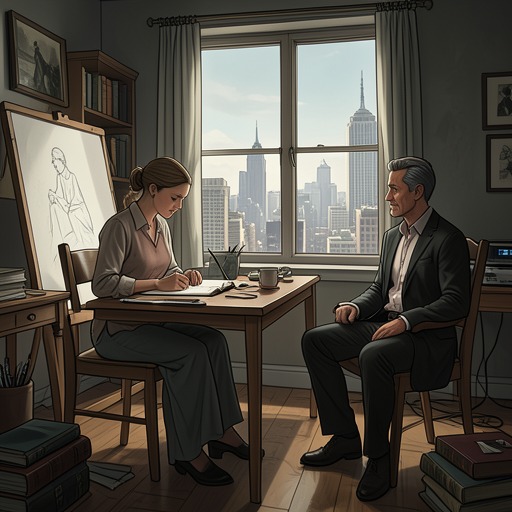
A second clouded-glass paperweight appears in Miranda’s story. At a dinner attended by Clark, Arthur’s oldest friend, Clark brings a beautiful paperweight from a museum gift shop in Rome. Miranda later enters Arthur’s neat study, finds the gift there, and holds it. Its weight pleases her; she thinks of looking into a storm. She tells herself she is taking it back to her own study to sketch, but knows she will keep it forever.
The novel gives this paperweight a different immediate history from Kirsten’s: Clark brings it as a gift, and Miranda takes it from Arthur’s study. It does not establish in these scenes that the two appearances are the same physical object. Their resemblance nevertheless makes the paperweight a recurring form through which the narrative attends to beauty, possession, and attachment. In Miranda’s hands it prompts an intention to draw and keep; in Kirsten’s, it is already a keepsake whose giver has become difficult to recall. Both encounters turn a decorative object into something personally charged without making it useful in any ordinary sense.
Material Memory After the Collapse
The paperweight’s persistence gains force beside the disappearance of electronic media. The novel describes the loss of the Internet and social media, then shows the network going dark after the television channels have dwindled to static, test patterns, or emergency broadcasts. In Traverse City, an inventor pedals a stationary bicycle to power a laptop while searching for the Internet. The screen displays a message that the webpage is unavailable. Kirsten is fascinated less by a recovered network than by electricity itself and imagines lamps, a nightlight, a chandelier, and a brilliant stage. Alexandra finds the lit screen magical; August looks at it with a lost expression.
At Severn City Airport, televisions likewise display silent test patterns. By Year Fifteen, children are taught about electronic devices, satellites, and a worldwide Internet that had connected everything; for them, those systems are difficult to imagine as lived experience. Against those vanished channels of communication, the paperweight offers no access to information and cannot restore what has been lost. Its scale is smaller: glass in a palm, carried through abandoned houses and remembered imperfectly. The contrast is not that one object replaces a global network, but that the novel lets a modest, durable keepsake retain a personal meaning after the systems that once linked distant lives have failed.